Sustainability in Healthcare Challenge

Sustainability in Healthcare Challenge

Advance sustainable healthcare innovation with MDI's Sustainability in Healthcare Challenge—funding bold solutions to reduce waste and emissions.

Sustainability in Healthcare logo in white coloring

What is your bold solution to reduce the environmental impact of the healthcare system?

Despite its mission to improve human health, the healthcare industry contributes to environmental harm, adversely affecting our patients and communities. Indeed, in the United States, 8.5% of greenhouse gas emissions are generated by our medical system, and the industry is the second leading contributor to landfill waste. We are seeking creative and bold solutions to reduce this harmful impact and accelerate the healthcare sustainability movement.

The Office of Sustainability in the Health Sciences, Office of Multidisciplinary Innovations in the Health Sciences, and the Mascaro Center for Sustainable Innovation are introducing the Sustainability in Healthcare Challenge as the University of Pittsburgh’s first funding opportunity to advance sustainability in healthcare.

We invite you to submit proposals that align with our commitment to promoting environmental, economic, and social sustainability in healthcare.
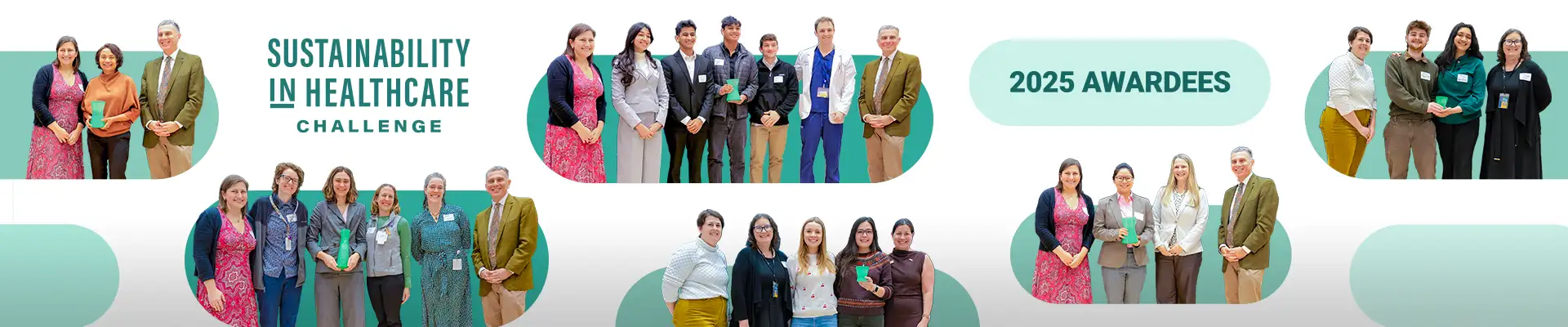
Composite image of photos from previous winners of the Sustainability in Healthcare Challenge

Award Details

Over $125,000 in total awards are available for funding. Three faculty projects will be selected to receive a $40,000 award, and up to two additional student projects will each receive $2,500 awards. The winning teams receives an award for direct costs and will be provided project management support to help execute a 12-month project to take the team’s solution one step further along the path of development. Commercialization support will be available, as appropriate.

Eligibility

Scope: Eligible projects should propose practical, innovative solutions that reduce healthcare’s environmental impact while maintaining or improving quality and patient outcomes. Submissions should demonstrate feasibility, measurable impact, and potential for real-world implementation and scale.

Team: Teams that enter must be led by at least one University of Pittsburgh faculty member (from any department, any level). Additional team members can be students (graduate or undergraduate), postdocs, and/or fellows. The team can include healthcare providers and individuals from other educational institutions or non-academic organizations such as community groups or industry partners. The Sustainability in Healthcare Challenge hopes to bring together a group of problem solvers who may not otherwise have considered working on a team.

How It Works

This program is a multi-round competition.

Round One: Application materials can be found on the InfoReady website.

Application Deadline: Friday, August 7th 2026 by 11:59 p.m.

Please direct any questions about allowable expenses to Annie Gohn at amg459@pitt.edu.

Applications Open

As examples, we welcome innovative projects related to healthcare that have positive impact on the environment by:

  • Reducing excess care
  • Reducing the carbon footprint of the care we provide
  • Reducing waste related to care
  • Reducing the environmental impact of the healthcare supply chain
  • Educating healthcare providers about sustainable practices
  • Psychological approaches that promote environmental considerations
  • Increasing reusability and recyclability, thus promoting a circular economy
  • Creating renewable materials across the industry
  • Improving the healthcare infrastructure
  • Using electronic medical records to reduce environmental impacts
  • Reducing the environmental impact of the research we conduct

Special consideration will be given to projects that include teams that:

  • Foster innovative research that addresses sustainability challenges in healthcare.
  • Develop sustainable health processes, technologies, and practices.
  • Promote interdisciplinary collaborations with a focus on developing partnerships between the health sciences, the Mascaro Center for Sustainable Innovation, and a clinical partner.
  • Encourage the adoption of sustainable practices within healthcare systems and communities.
  • Have the potential to lead to additional funding.
  • Demonstrate strong potential for rapid translation and/or commercialization of the proposed solution into real-world healthcare settings.
  • Problem Definition
    • Does the proposal clearly identify and address a key sustainability challenge within the healthcare system? Is the problem well-defined and significant in its potential environmental, social, or economic impact?
  • Solution Innovation & Originality
    • How novel is the proposed solution compared to current practice or the status quo? Does it offer a creative approach or shift in clinical, operational, or research paradigms to address an unmet sustainability need? Applicants should provide context on currently available solutions, technologies, or practices, and clearly define how their approach is distinct or represents advancement.
  • Project Plan & Milestones
    • Is the proposed project realistic and appropriate in scope for a 12-month, $40,000 award? Are clear milestones outlined, and do they align with the goal of reducing the environmental impact of healthcare?
  • Environmental Impact & Translation
    • Does the proposal include defined metrics to evaluate environmental sustainability outcomes? Is there a clear and feasible plan for translating or commercializing the solution for real-world implementation?
  • Team
    • Does the team demonstrate multidisciplinary expertise and collaboration? Preference will be given to proposals that include partnerships across two or more groups/centers and involve a clinical collaborator.

Project Facilitation Phase:

  • This phase provides semifinalists with personalized input to help move their project forward, including several advisory meetings to discuss regulatory paths, contracting, IP, budget, data security, and more.

Note on Artificial Intelligence (AI) Online Tools:

  • Applicants are discouraged from using any public AI engines for these Press Releases (ex: ChatGPT, Gemini, Perplexity). Any material uploaded to these engines become public domain, potentially invalidating intellectual property of the teams. Private AI tools (ex: University of Pittsburgh approved AI tools) where data is restricted may be used, but we ask that applicants and reviewers make minimal use of these tools.

Path to Impact:

  • We support projects across the continuum of research and translation, including early discovery, proof-of-concept development, validation, clinical or community implementation, and broader translation and/or commercialization. Applicants should describe the project’s current stage of development and outline the key steps needed to advance the work toward meaningful real-world impact. Applicants should identify anticipated milestones, potential implementation or commercialization pathways, and, where applicable, metrics that will be used to evaluate health, community, environmental sustainability, and/or biomedical impact outcomes.

Intellectual Property:

  • Before you share your ideas with outside parties or present your work publicly (conferences, publications, or media), we encourage you to submit an Invention Disclosure to the Innovation Institute.

Please email Annie Gohn at amg459@pitt.edu if you would like to initiate intellectual property discussions or draft an Invention Disclosure.

Contact Us

Whether you’re refining a proposal or exploring a new project, we’re here to help bring your vision to life. 

This site is protected by reCAPTCHA and the Google Privacy Policy and Terms of Service apply.